Our research connects electrochemical materials, physics-based modeling, scientific machine learning, and system-level analysis to design safer, higher-performing batteries and sustainable electrochemical technologies.
Research Areas
Current application areas span batteries, electrochemical manufacturing, scientific AI, automated experimentation, and the infrastructure needed to deploy electrochemical technologies.
Battery Electrodes and Interfaces Design
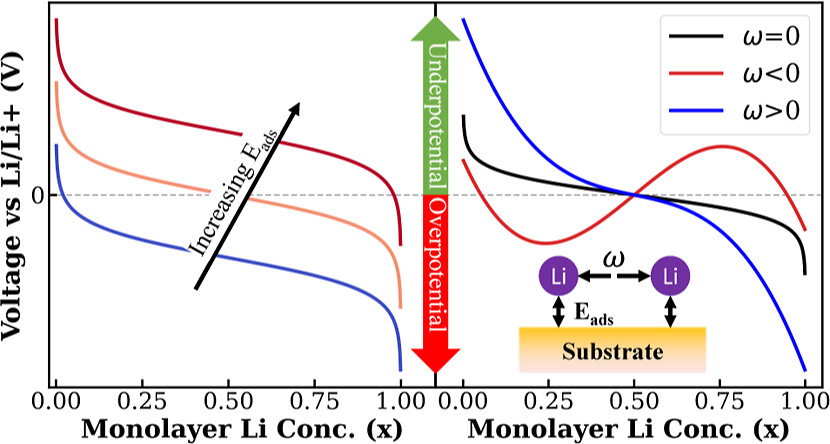
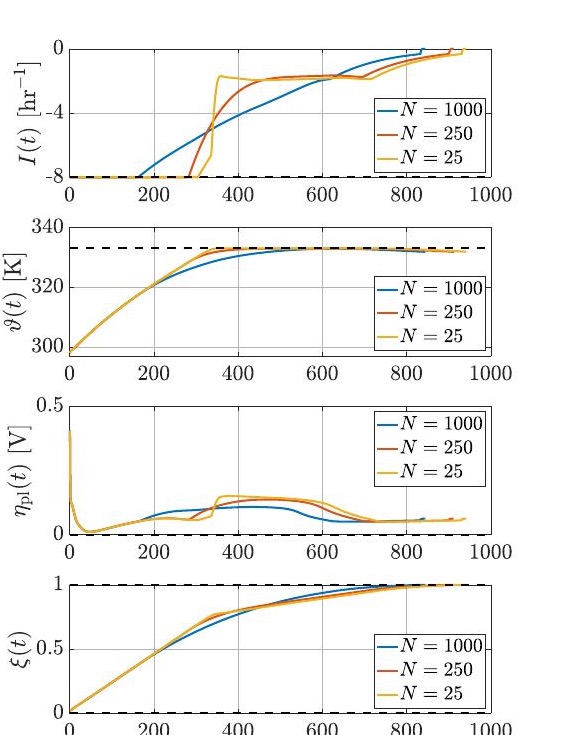
We design and model materials for next-generation batteries, including cathodes, anodes, electrolytes, and electrochemical interfaces. This work aims to improve energy density, power capability, safety, lifetime, and performance under demanding operating conditions such as fast charging, low temperature, and high-rate cycling.
Battery Electrolyte Discovery
We develop new approaches for discovering and optimizing battery electrolytes. This work spans liquid and solid electrolyte systems, ion transport, solvation structure, interfacial stability, and formulation design for lithium-ion, lithium-metal, and emerging battery chemistries.
High-Energy-Density Batteries for Electric Aviation
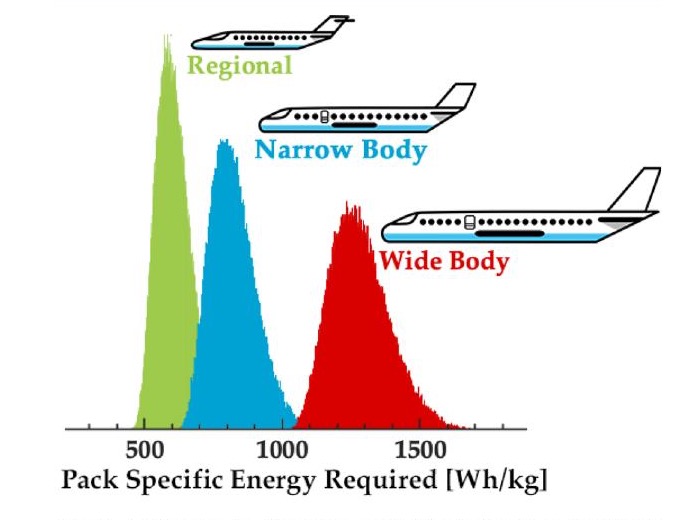
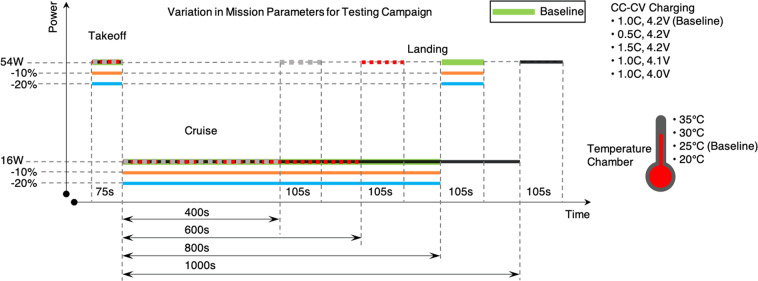
We develop battery materials, models, and design principles for electric aviation, where cells must meet stringent requirements for specific energy, power and lifetime. This research connects materials design to aircraft-relevant duty cycles and system-level performance targets.
Battery Modeling, Management, and Control
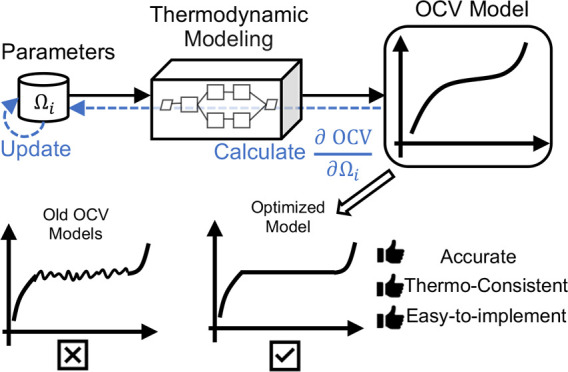
We build models that connect electrochemical mechanisms to cell- and system-level behavior. These models support performance prediction, degradation analysis, state estimation and optimization.
Electrocatalysis and Electrochemical Manufacturing
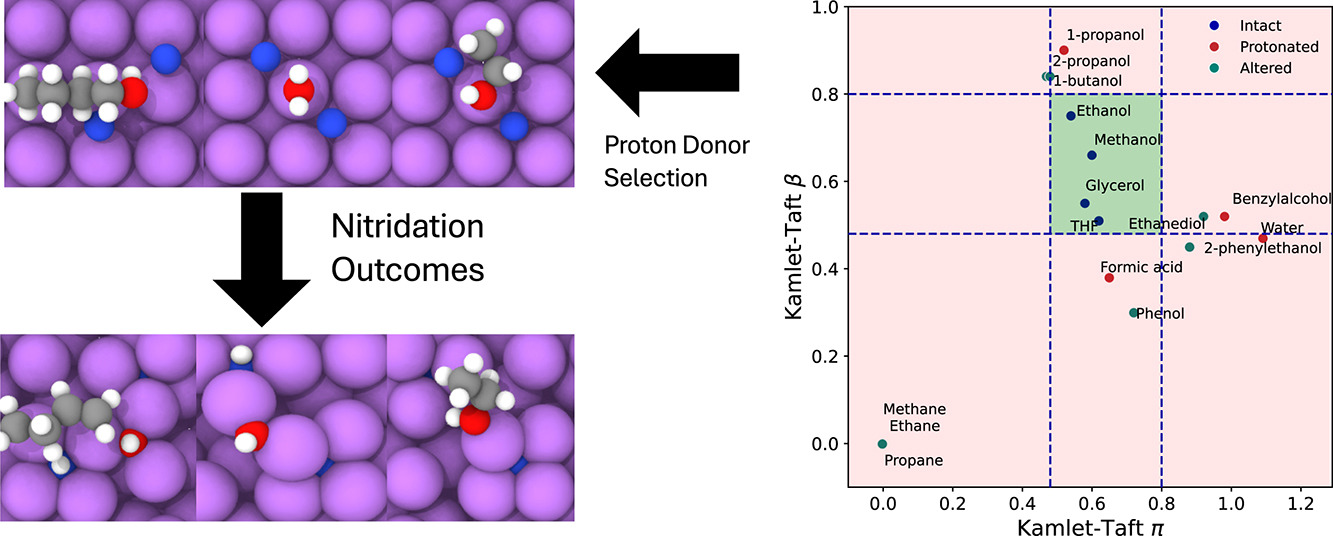
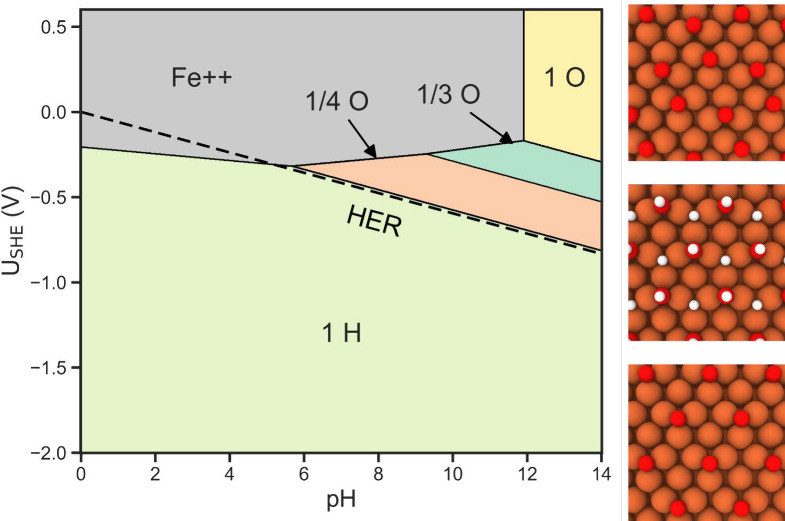
We design and analyze electrochemical systems for sustainable chemical and materials production. Research areas include ammonia synthesis, low-carbon iron and cement production, and broader efforts to electrify chemical manufacturing.
Electric Mobility and Charging Infrastructure
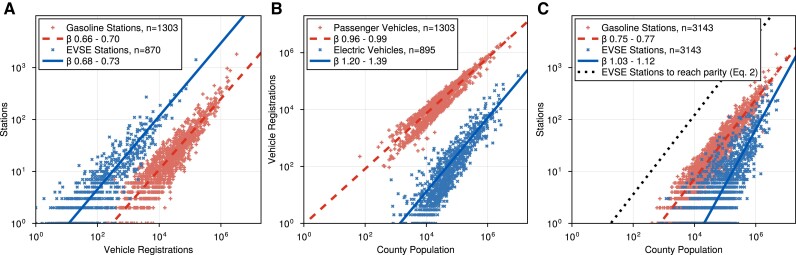
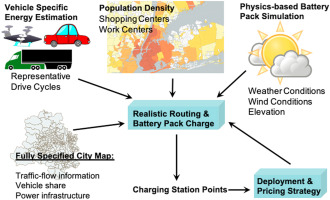
We have studied the broader energy-system implications of battery-powered transportation, including electric vehicle adoption, charging infrastructure deployment, battery cost modeling, and techno-economic analysis. This work connects electrochemical technology development to transportation and infrastructure planning.
Foundation Models for Molecules and Materials
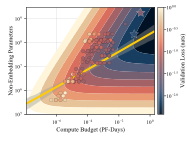
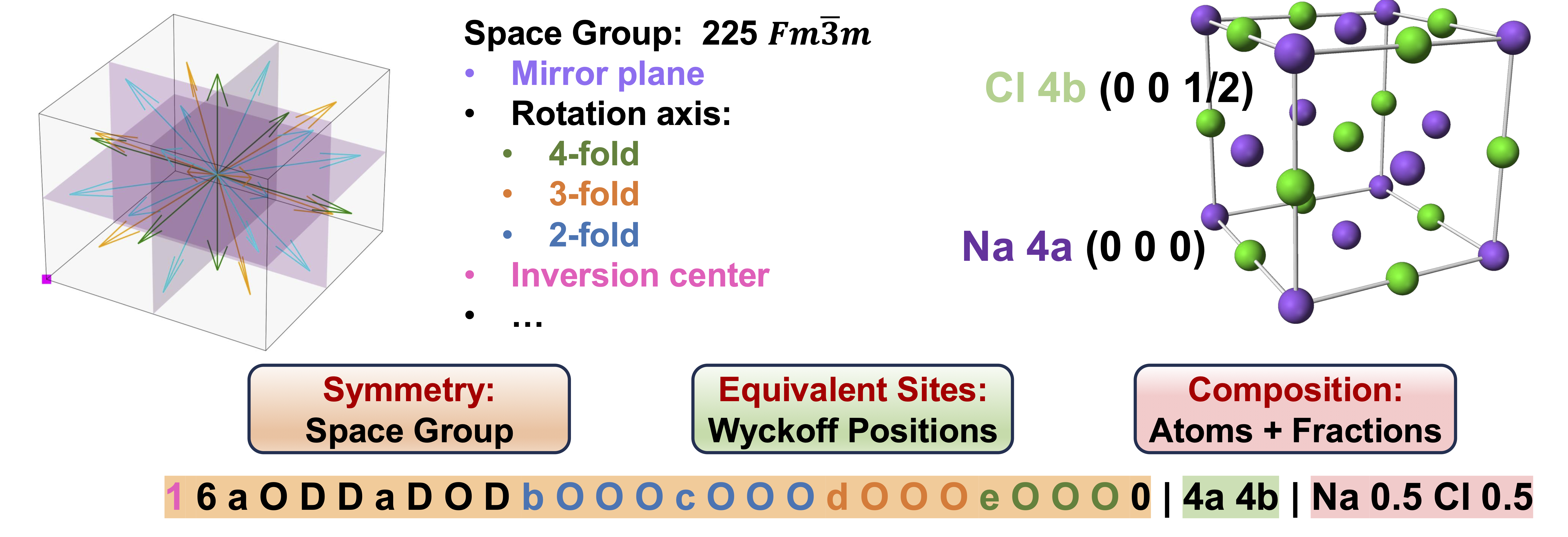
We train and apply large-scale foundation models that learn general representations of molecules, crystals, and materials from large datasets. These models can be adapted to downstream tasks such as property prediction, electrolyte screening, molecular discovery, and materials design.
AI Agents for Scientific Research
We develop AI agents that can plan, execute, monitor, and refine scientific workflows. In materials simulation, this includes agentic systems that coordinate structure generation, density functional theory workflows, convergence testing, high-performance computing job submission, error handling, and result interpretation. The DREAMS framework is an example of this direction, using a hierarchical multi-agent system for DFT-based materials simulation.
Automated Experimentation and Self-Driving Labs
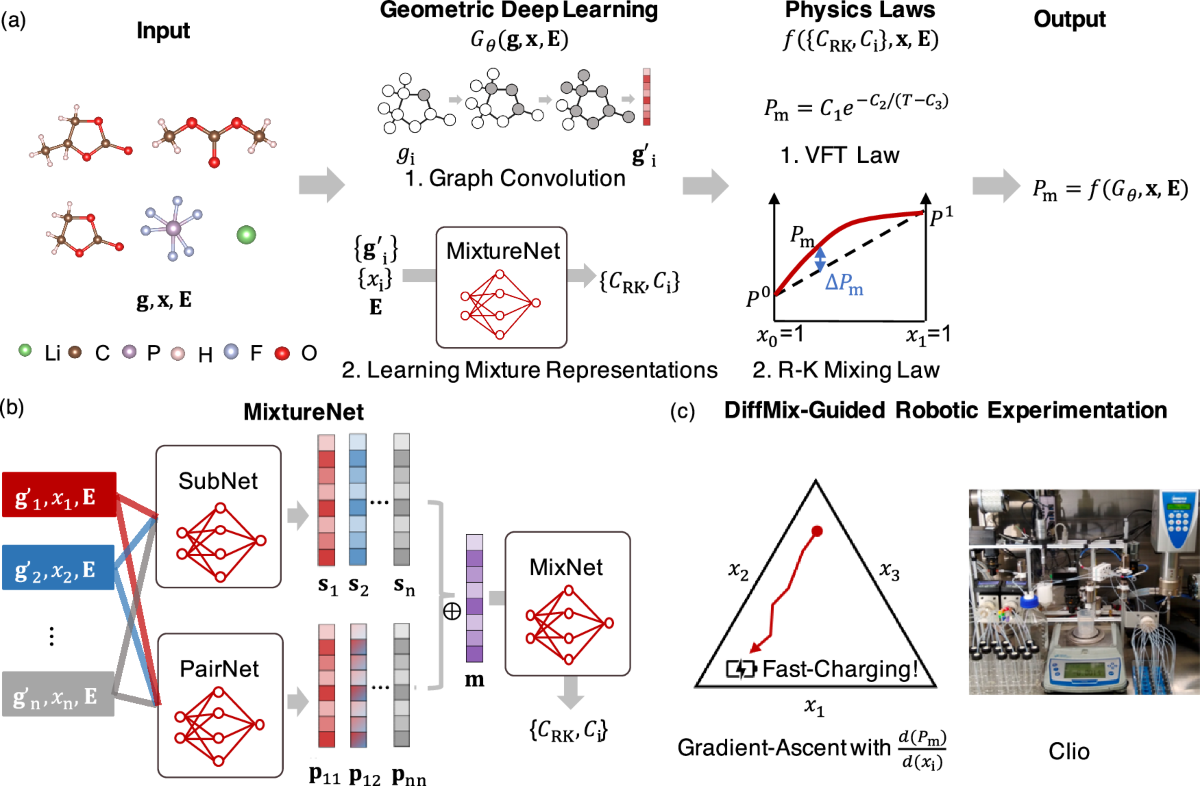
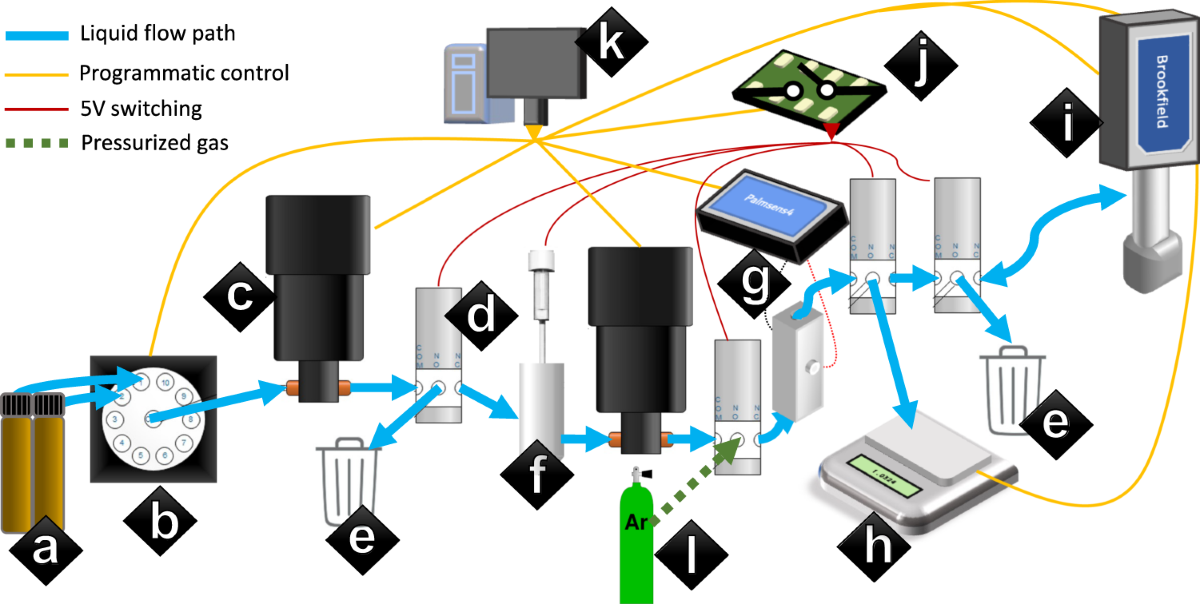
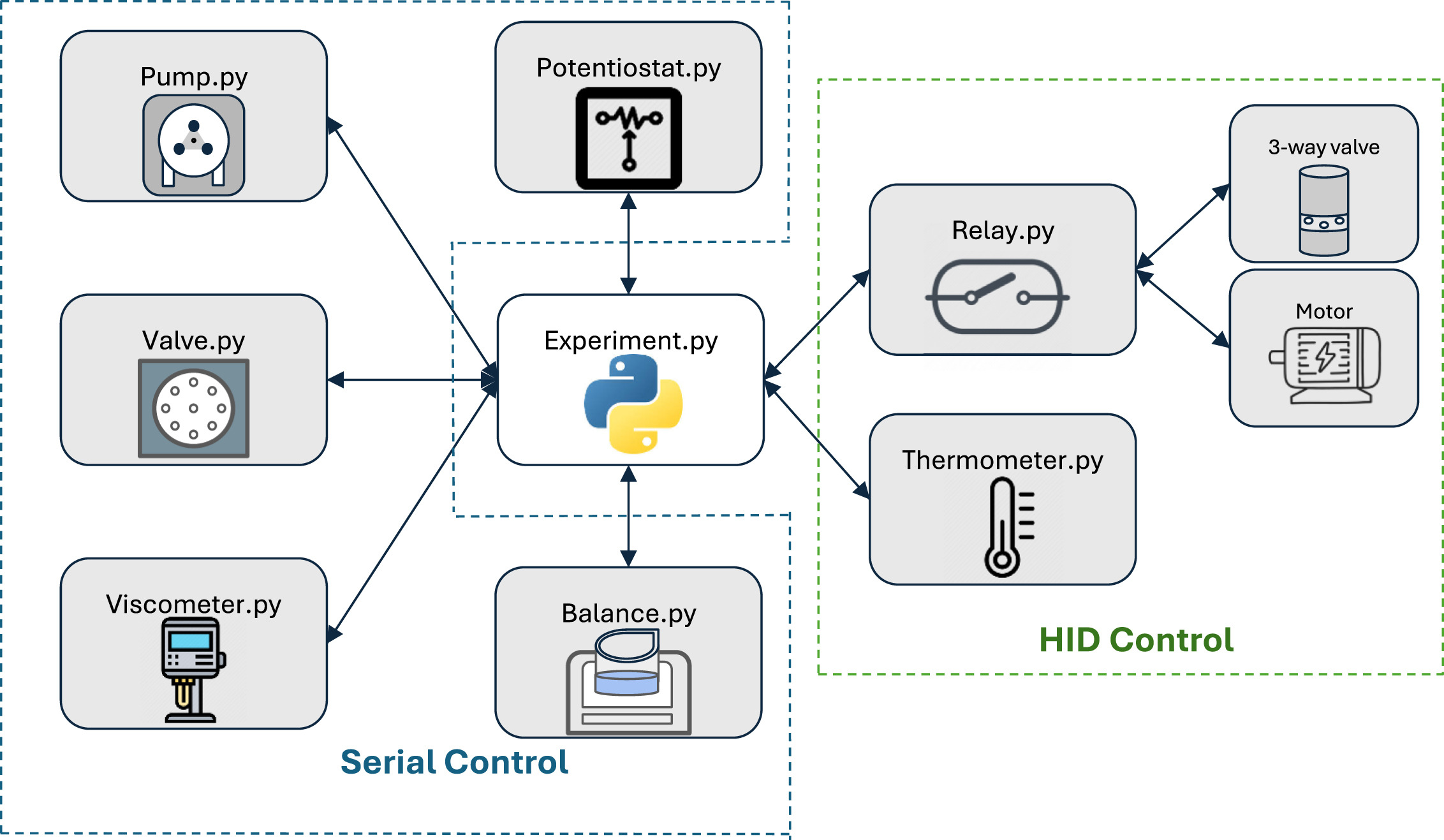
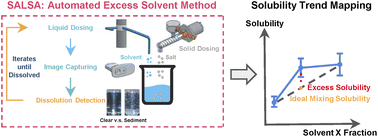
We develop and use automated experimental workflows that combine robotics, data infrastructure, and machine learning. These platforms support rapid preparation, measurement, and optimization of electrolyte formulations. We developed the Clio robotic platform, which integrates multiple experimental modules under a shared software framework, ElyteOS. It autonomously prepares liquid formulations, performs electrochemical measurements, and characterizes their properties. Complementing Clio, the SALSA (Salt Solubility Assessment) module uses a deep learning model for optical recognition, capturing real-time dissolution curves.
Research Methods
The group combines electronic-structure simulation, molecular dynamics, continuum electrochemical modeling, differentiable physics, phase-field modeling, and high-performance computing.
First-Principles Electronic-Structure Modeling
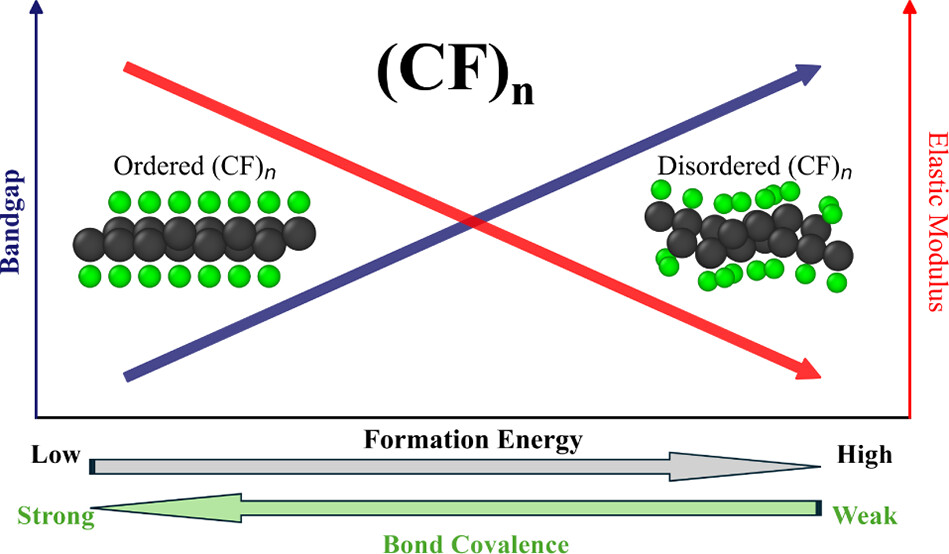
We use Density Functional Theory (DFT) to study structure-property relation, material stability, transition states, electronic structures, and interfacial reactions. These simulations provide molecular- and atomic-scale insight into electrochemical materials and properties.
Molecular Dynamics
We use Molecular Dynamics (MD) to study solvation structures and transport properties (diffusivity, ionic conductivity, viscosity, etc) of electrolytes to facilitate next-generation electrolyte design. We also apply and develop machine learning interatomic potentials for studying disordered materials and performing high-fidelity large-scale atomistic simulations.
Continuum Scale Electrochemical Modeling
We develop models that bridge length and time scales, from atomistic chemistry to transport, interfaces, cell behavior, and system-level performance. This includes models for next generation chemistries such as silicon anodes and conversion cathodes which can not be fully studied using conventional Doyle-Fuller-Newman or Single Particle battery models.
Differentiable Physics
We develop solver-in-the-loop style differentiable models for the purposes of parameter estimation and inverse design. Recent work includes an end-to-end differentiable approach for connecting electrochemical theory with experimental data and learning optimal TVD flux limiters for finite volume schemes. In the past we have also worked on learning closure models using this approach for wall bounded turbulent flows.
Phase-Field Modeling
We use phase-field models to study morphological evolution in electrochemical materials, with emphasis on how transport, reaction kinetics, and interfacial energetics govern dendrite growth, deposition stability, and degradation. Representative examples include phase-field simulations of lithium electrodeposition and the design of liquid crystalline electrolytes for stabilizing metal deposition and suppressing dendrites.
High-Performance Computing
We use high-performance computing to scale simulations, materials screening, electrochemical modeling, AI agents, and foundation model training. Large-scale computing enables the group to explore chemical and materials spaces that would be inaccessible with conventional workflows. We have dedicated access to the Artemis high-performance computing cluster, housed in the University of Michigan Lighthouse, which provides CPU, GPU, and large-memory resources for molecular simulation, machine learning, and agentic workflow development. In addition to Artemis, the group has received substantial national cyberinfrastructure allocations through the NSF ACCESS and DOE INCITE programs.